
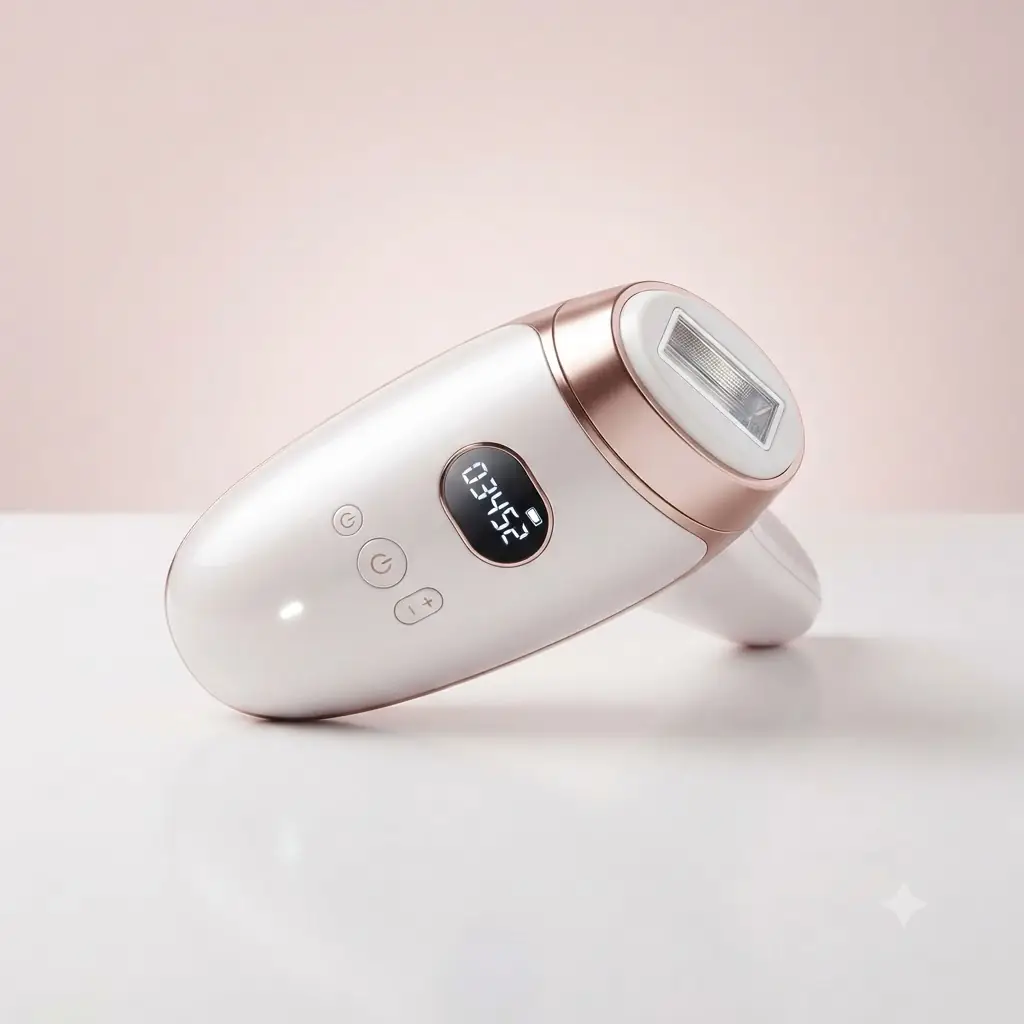
The honest answer to "how much does at-home IPL cost" is: more upfront than a pack of razors, but far less than almost anything else once you look past the first month. A quality at-home IPL device is a one-time purchase — no per-session fees, no recurring salon bookings, no subscription. The real question worth answering is not the sticker price on its own, but how that one-time cost stacks up against what you would otherwise spend on shaving, waxing, sugaring, professional laser or electrolysis over the years you would actually use it. That comparison, done honestly, is where at-home IPL's value becomes clear.
The short version: At-home IPL costs more than a razor on day one but less than every other method within one to two years of regular use, because it is a single purchase rather than a recurring bill. Shaving and waxing costs never stop. In-clinic laser costs far more overall despite being billed per session. IPL's real value shows up over the multi-year horizon, not the first purchase.
The real cost comparison: 5 years of use
Sticker prices in isolation are misleading, because some methods are cheap per use and expensive forever, while others are the opposite. Here is how the common hair removal methods stack up when you look at total spend over roughly five years of consistent use on a couple of body areas (say, legs and underarms).
| Method | Ongoing cost | 5-year pattern |
|---|---|---|
| Shaving | Blades/cartridges, replaced regularly | Low per use, but never stops — steady spend that adds up year after year with no reduction in hair growth. |
| Waxing (at home) | Wax strips or kits, repurchased monthly | Moderate recurring cost, plus your own time and mess each session. |
| Waxing (salon) | Appointment fee every 3-6 weeks, per area | The most expensive recurring method for most people — hundreds of dollars a year, indefinitely. |
| Sugaring | Similar to waxing, DIY or salon | Comparable recurring cost pattern to waxing, whichever route you choose. |
| At-home IPL | One-time device purchase | Front-loaded cost that flattens to near zero after the initial course — reusable indefinitely by the whole household. |
| In-clinic laser | Per-session fee, per body area | By far the highest total spend — a full course plus years of maintenance sessions, each billed again. |
| Electrolysis | Per-session, billed by time | Slow and typically the most expensive per treated area, though it is the only method that works on all hair colours. |
The pattern that matters: every recurring method keeps costing money for as long as you keep removing hair, which for most people is decades. A one-time device is the only option on this list whose cost curve actually flattens.
Shaving: cheap per use, expensive over time
Shaving has the lowest barrier to entry — a razor costs very little, and almost everyone already owns one. The catch is that it never stops costing money and never reduces the amount of hair you have to deal with. Replacement cartridges are one of the more marked-up items in any drugstore, and a household that shaves regularly across a few areas can easily spend more on blades over two or three years than an IPL device costs once. Shaving also carries its own recurring cost in time — it needs to be repeated every few days indefinitely, with no cumulative benefit, since it does nothing to the follicle itself.
Waxing and sugaring: the most expensive if you go to a salon
Salon waxing is usually the single most expensive way to manage body hair long-term, precisely because you are paying for a professional's time on a recurring, near-monthly schedule, for as long as you want to stay hair-free. Across multiple areas, that adds up to a meaningful annual bill that never decreases. At-home waxing and sugaring kits are cheaper than the salon but still a repeat purchase, and neither approach reduces future hair growth the way light-based methods do — you are paying to remove the same hair, at the same rate, indefinitely.
At-home IPL: front-loaded, then nearly free
An at-home IPL device flips the cost curve. You pay once, upfront, for a device that then covers unlimited sessions across unlimited body areas for as long as you own it — and it can be shared across an entire household at no extra cost per person. The lamp inside a quality device is typically rated for tens of thousands of flashes, which works out to years of regular use before it would ever need replacing, and many devices, including FlashSmooth Core, have no separate cartridges to buy at all.
The other part of IPL's value is that, unlike shaving or waxing, it is designed to genuinely reduce how much hair grows back over a course of sessions, rather than just temporarily removing what is already there. That means the ongoing time cost drops too — most people move from a frequent shaving or waxing routine to occasional light maintenance sessions once they complete the initial course. For the mechanics of why that reduction happens, see our guide to how IPL hair removal works, and for the honest timeline on when it kicks in, read does at-home IPL actually work.
In-clinic laser: the highest total cost
Professional laser delivers strong, fast results, but it is billed per session and per body area, and a full course commonly runs six to eight or more sessions before you see the full reduction. Multiply a per-session clinic fee by that many visits, across more than one body area, and the total for a single course alone often lands well into four figures — before any of the maintenance sessions most people book in the years after. It is not that laser is bad value for what it delivers; it is a premium service with trained operators and stronger equipment. But dollar for dollar over several years, it is the most expensive route on this list for most people, which is exactly why so many choose at-home IPL as their everyday method and save clinic visits for specific situations. We compare the two properly, beyond just cost, in IPL vs laser hair removal.
Electrolysis: slow, thorough, and priced accordingly
Electrolysis treats hair follicle by follicle with a fine probe and electrical current, which is why it is the only method on this list that works regardless of hair colour — it does not rely on pigment contrast the way IPL and laser do. That thoroughness comes at a cost: sessions are billed by time, treatment is slow by nature, and a full area can take many sessions over a long period. For blonde, red, grey or white hair, where light-based methods simply do not work, electrolysis is the realistic option despite the higher price — it is solving a problem IPL cannot.
The break-even point: when IPL starts saving you money
For most people comparing an at-home IPL device against ongoing salon waxing, the device pays for itself within the first one to two years — sometimes sooner, depending on how many areas and how often you were waxing. Against shaving, the break-even point takes a little longer since blades are individually cheap, but it still typically lands within two to three years for a household that shaves regularly, and after that every cartridge you are not buying is pure savings. Against in-clinic laser, the comparison is not even close: a single IPL device usually costs less than one or two clinic sessions, let alone a full course.
The one variable that changes this math entirely is suitability. If your skin tone or hair colour means IPL will not work for you — see our skin-tone suitability guide to check — then none of these savings apply, because a device that cannot deliver results is not a bargain at any price. Cost comparisons only make sense once you have confirmed you are a suitable candidate.
Hidden costs to watch for either way
- Replacement cartridges. Some IPL devices use limited-flash cartridges that need repurchasing — check this before you buy, since it changes the long-term math. FlashSmooth Core uses a long-life lamp with no separate cartridge to replace.
- Salon add-ons. Tipping, numbing cream, and package upsells can push salon waxing costs meaningfully higher than the base price you were quoted.
- Time, not just money. Recurring methods also cost you recurring appointments or shaving time — a real cost even if it does not show up on a receipt.
- Devices that do not suit your skin or hair. The worst value outcome is buying any hair removal method — device or salon service — that was never going to work for your Fitzpatrick type or hair colour.
The bottom line
At-home IPL is not the cheapest option on day one, but it is the best value over any realistic multi-year horizon for suitable candidates. It replaces a recurring bill with a single purchase, tends to pay for itself within one to two years against salon waxing and within two to three against habitual shaving, and costs a fraction of a single course of in-clinic laser. The methods that stay expensive forever — salon waxing, regular shaving, professional laser maintenance — are expensive precisely because they are designed to be repeated indefinitely. A device you own outright is the only option on this list whose cost curve actually flattens out.
The real cost of hair removal is not the price tag on day one — it is what you are still paying for it in year three.
FlashSmooth Core is a one-time purchase built to replace years of razors, wax appointments and salon bills, backed by a 90-day money-back guarantee so you can confirm it works for your skin and hair before you commit.