
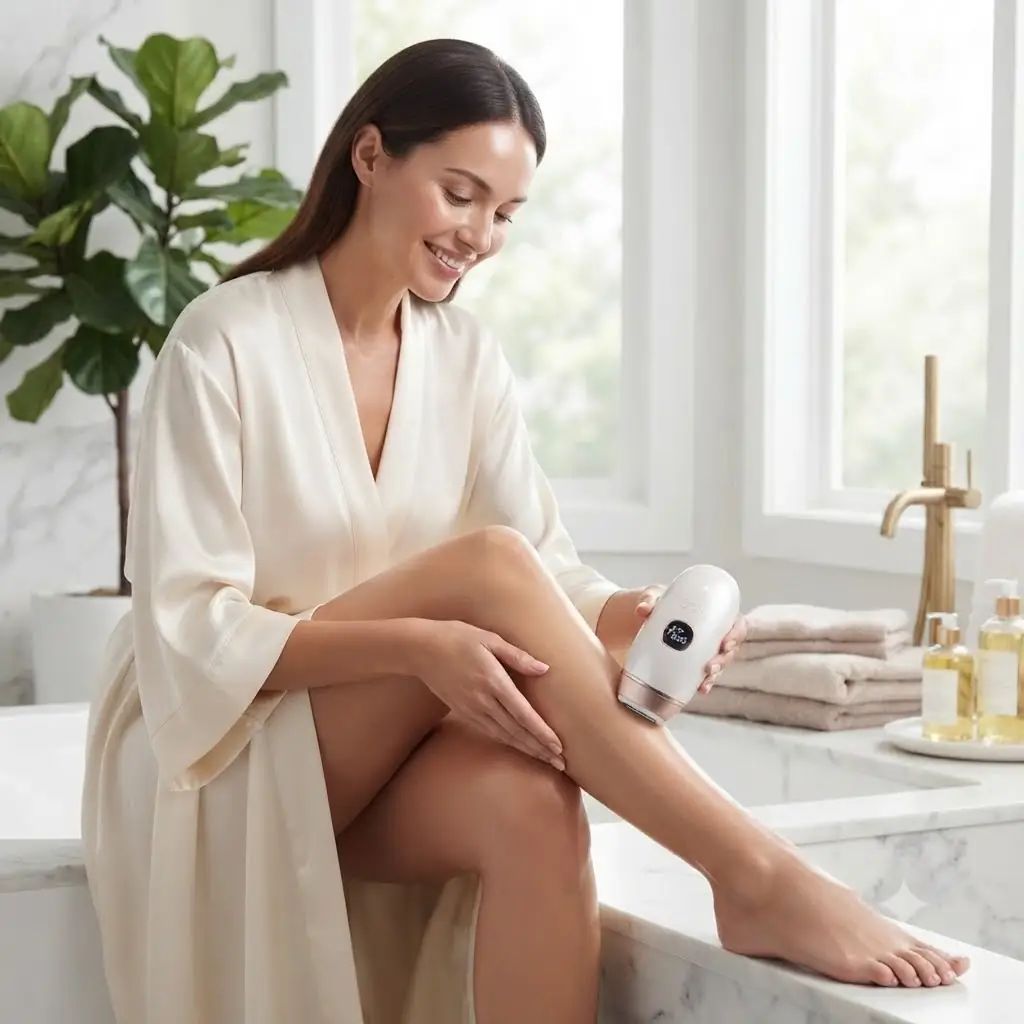
If you are asking does IPL work on my skin, you deserve a straight answer before you spend a penny. Here it is: at-home IPL works by targeting the contrast between dark hair and lighter skin. That single fact means IPL works brilliantly for some people and does not work at all for others. Searches for IPL for dark skin tones are so common precisely because most brands stay vague about who it fails. We would rather qualify you honestly than sell you a device that cannot deliver — so this is our complete, no-spin IPL skin tone chart and suitability guide.
The short version: IPL is a strong match if your skin is Fitzpatrick I–IV and your hair is dark brown or black. If your skin is very deep (type VI) or your hair is blonde, red, grey or white, IPL is the wrong tool — and we will point you to what actually works instead.
The one rule that decides everything: IPL needs contrast
Intense Pulsed Light does not "see" hair the way you do. It sends broad-spectrum light into the skin, and that light is absorbed by melanin, the pigment that gives both your hair and your skin their colour. When melanin absorbs the light, it converts it to heat. In the hair, that heat travels down the shaft to the follicle and disables its ability to grow hair effectively. This is why IPL delivers long-lasting hair reduction — not permanent removal, and we will always be clear about that distinction.
The catch is in the physics. IPL wants the melanin in your hair to be a much bigger, darker target than the melanin in your surrounding skin. Dark hair on light skin gives the device an obvious bullseye: the light rushes to the hair and mostly ignores the skin. But if your skin also holds a lot of melanin, the light gets absorbed by the skin itself. That is uncomfortable at best and can cause burns or discolouration at worst — and it wastes energy that should have reached the follicle. No contrast, no reliable result. Everything below is just this one rule applied to real skin and real hair. You can read the full mechanism in our guide on how IPL hair removal works.
It also helps to understand why IPL is a light-based tool and not a razor with a battery. Because the energy has to be absorbed by pigment and converted to heat, the entire method lives or dies on how much pigment is where. That is the honest reason no at-home device can promise universal results: it is not a marketing choice, it is optics. Two people can buy the identical device, follow the identical routine, and get completely different outcomes purely because of the contrast between their hair and their skin. Before you judge whether a device is "good", you first have to judge whether you are the person the physics favours. That is what this guide is for.
The Fitzpatrick skin-tone scale
Dermatologists classify skin using the Fitzpatrick scale, a six-type system based on how skin responds to sun. It is the industry-standard way to judge IPL suitability, and reputable dermatology consensus is consistent on this: at-home IPL is designed and tested for lighter skin. Find your type honestly — err toward the deeper type if you are unsure.
| Fitzpatrick type | Skin description | IPL suitability |
|---|---|---|
| Type I | Very fair, always burns, never tans | Yes — suitable |
| Type II | Fair, burns easily, tans minimally | Yes — suitable |
| Type III | Light-medium, sometimes burns, tans gradually | Yes — suitable |
| Type IV | Olive to light brown, rarely burns, tans easily | Yes — suitable |
| Type V | Brown skin, very rarely burns, tans deeply | Caution — generally not recommended for at-home IPL |
| Type VI | Deeply pigmented dark brown to black skin | No — not recommended |
To be direct and respectful about it: if you have Type VI deep or dark skin, at-home IPL is not for you, and any brand telling you otherwise is not being straight. Two things go wrong at once. First, it is unsafe — the light targets the abundant melanin in your skin, which can cause burns, blistering and lasting pigment changes. Second, it is ineffective — the light struggles to distinguish hair from skin, so even a careful session gives weak results. This is a biological limit of the technology, not a limitation of you. The good news is that better tools exist, and we cover them below.
Type V sits in the honest grey zone, and it is worth being careful here. Some brown-skinned people at the lighter end of Type V do get results at the lowest, most cautious energy settings — but the safety margin is thin, the risk of pigment change is real, and the results are usually weaker and slower than for lighter types. That is why we place Type V in the "caution — generally not recommended" column rather than a confident "yes". If your skin sits anywhere near this line, treat that as a reason to slow down, not to gamble. A patch test and a clinic consultation are far cheaper than fixing a burn.
One more honest note on tanning: a fresh tan temporarily loads your skin with extra melanin and can push a normally-suitable type into unsafe territory. If you have been in the sun, let the tan fade before any IPL session, regardless of your baseline Fitzpatrick type. The scale describes your natural, untanned skin — not your skin in July.
Hair colour matters just as much
Passing the skin-tone check is only half the story. Because IPL needs melanin in the hair to work, the colour of your hair is just as decisive. Someone with perfect Type II skin but naturally blonde hair will still be disappointed — there is simply not enough pigment for the light to grab onto.
| Hair colour | Works with IPL? |
|---|---|
| Black / dark brown | Best — highest melanin, strongest results |
| Mid / medium brown | Works, but slower — expect more sessions |
| Blonde / light | Poor — too little pigment to absorb the light |
| Red / auburn | Poor — pheomelanin absorbs light poorly |
| Grey / white | Does not work — no melanin at all |
The reason grey and white hair does not respond is simple: those hairs have lost their melanin entirely, so there is nothing for the light to heat. Red hair contains mostly pheomelanin, a pigment that absorbs IPL light poorly, so results are unreliable. Blonde and very light hair sit in the same weak-response category. If your unwanted hair is light, red, grey or white, please do not buy IPL expecting it to work — it will not, no matter how many sessions you do.
A common and completely understandable question is whether you can just dye light hair dark first to give the light something to grab. You cannot — hair dye colours the visible shaft above the skin, but IPL needs pigment inside the follicle down at the root, which dye does not reach. The same goes for self-tanner on the skin: it changes the surface colour without changing the melanin the device is actually reading, and it can even confuse a skin-tone sensor. There is no shortcut around the biology. If the pigment is not naturally there, IPL has nothing to work with.
So is IPL right for you?
Cut through everything with this one honest test. At-home IPL is a genuinely good fit for you if both of these are true:
- Your skin is Fitzpatrick I–IV (very fair through olive / light brown), and
- Your hair is dark brown or black (mid-brown works, just more slowly).
If both boxes are ticked, you are an ideal candidate and can expect the smooth, low-maintenance results IPL is famous for. If either box is not ticked — deep Type V–VI skin, or light, red, grey or white hair — IPL is the wrong tool. That is not a sales pitch dressed up as caution; it is us telling you where not to spend your money.
It is worth setting expectations even for the ideal candidates. Suitable does not mean instant. IPL works over a course of treatments — typically spaced across several weeks to catch hairs in the right growth phase — and it delivers long-lasting reduction, meaning fewer, finer, slower-growing hairs and occasional maintenance top-ups, not a single permanent zap. Anyone promising permanence from a home IPL device is overselling. Knowing that up front is part of being a happy customer rather than a disappointed one.
If IPL isn't right for you — better alternatives
We would rather send you to the right solution than sell you the wrong one. If the honest test above ruled you out, here are two genuinely effective options — no trash-talk, just facts.
Professional Nd:YAG / 1064nm laser
For darker skin (Fitzpatrick V–VI), an in-clinic Nd:YAG laser is the gold standard. Its long 1064nm wavelength passes more safely past skin pigment and targets the follicle deeper down, so a trained practitioner can treat darker skin tones safely and effectively — something at-home IPL simply cannot do. If your skin is deep and your hair is dark, a reputable clinic offering Nd:YAG is the honest recommendation. Our IPL vs laser guide breaks down the differences in full.
Electrolysis
If your issue is hair colour — blonde, red, grey or white — electrolysis is the answer. It does not rely on pigment at all; it uses a fine probe to disable each follicle directly, which means it is the one method that works on any hair colour and is recognised as truly permanent. It is slower and treats one hair at a time, but for light or greying hair it is the option that actually delivers.
You can also read the Cleveland Clinic's balanced overview of the pros and cons of at-home light-based hair removal for an independent view.
How FlashSmooth handles suitability
FlashSmooth Core includes a built-in skin-tone sensor that reads your skin before each flash and helps guide you toward safe, suitable use, alongside adjustable energy levels so you can build up comfortably. Peer-reviewed research on home-use IPL, such as this published home-IPL study, supports meaningful hair reduction for suitable users over a course of treatments.
But we will be blunt about the limits of any sensor: no sensor overrides the biology above. A skin-tone sensor is a safety guardrail, not a magic override. It cannot make IPL work on grey hair, and it cannot make deep Type VI skin safe to treat. If you are not a suitable candidate, the honest move is not to buy — and if you try FlashSmooth and it is not right for you, our 90-day money-back guarantee is the backstop that keeps us honest. We would rather refund you than pretend the physics is different. For more on safe use, see our guide on whether at-home IPL is safe.
Bottom line
IPL is a fantastic technology for the right person and a waste of money for the wrong one — and the difference comes down to contrast: dark hair on lighter skin. If your skin is Fitzpatrick I–IV and your hair is dark, you are an ideal candidate and IPL can give you long-lasting reduction at home. If not, we have pointed you to Nd:YAG laser or electrolysis, and we mean it. Remember too that IPL delivers long-lasting reduction, not permanent removal — honest expectations matter.
If your skin is Fitzpatrick I–IV with dark hair, you are exactly who FlashSmooth is built for — here is where to start, backed by the 90-day money-back guarantee.