
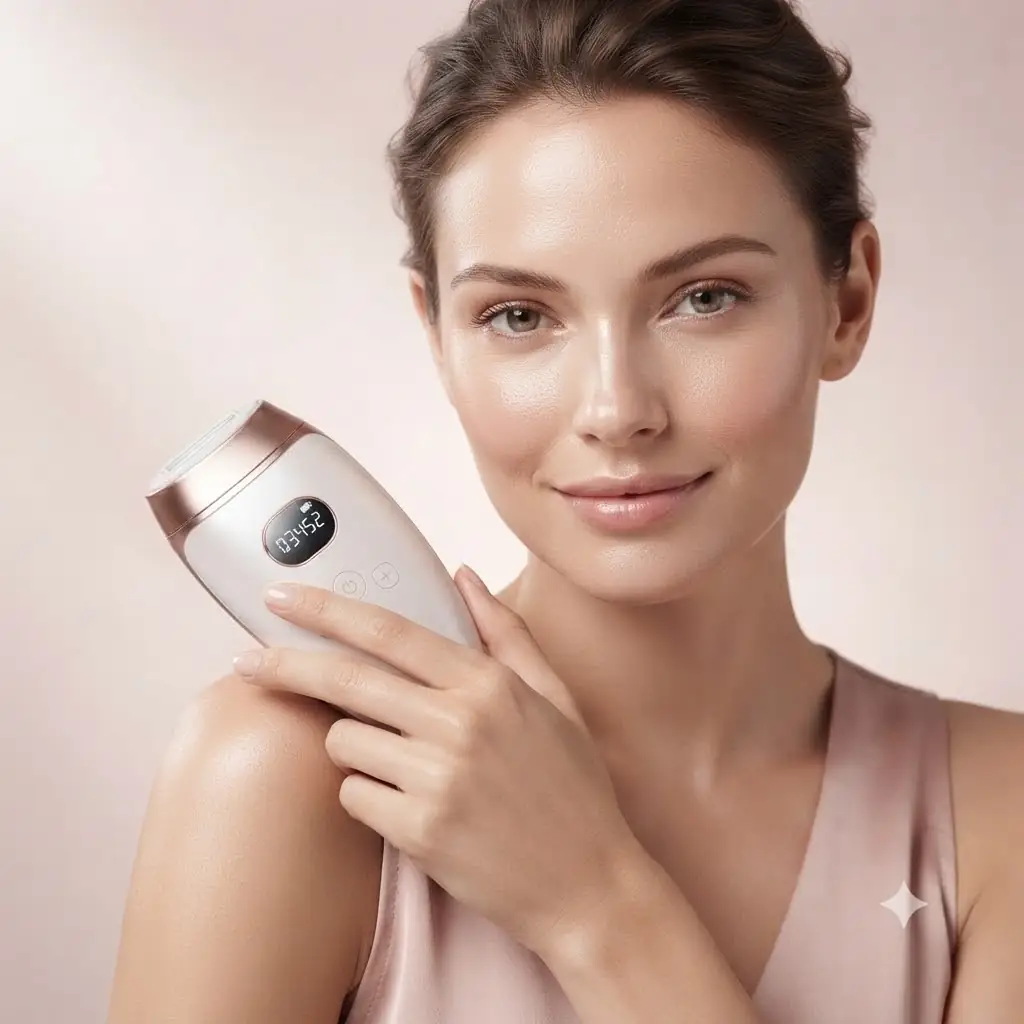
Is at-home IPL safe? For most people the answer is yes: at-home IPL is generally safe for suitable skin and hair when you follow the instructions — with some important exceptions we cover below. The risks that do exist come almost entirely from misuse or from using IPL on skin and hair it was never designed for. Used correctly, on the right candidate, an at-home IPL device delivers long-lasting hair reduction with only mild, temporary side effects for the vast majority of users.
The short version: At-home IPL is safe when used correctly on suitable skin (Fitzpatrick I–IV) with dark hair. It is not effective, and can be unsafe, on very dark skin (V–VI) and does not work on blonde, red, grey or white hair. IPL gives long-lasting reduction, not permanent removal. Patch test first, start low, protect your eyes, and never treat over tattoos, moles, or recently tanned skin.
The short answer
At-home IPL (Intense Pulsed Light) works by sending pulses of light into the skin, where the pigment in your hair absorbs that light and converts it to heat, disrupting the follicle. Because the technology depends on the contrast between dark hair and lighter skin, it is both safest and most effective on Fitzpatrick skin types I–IV paired with dark hair. On that combination, the light targets the hair rather than the surrounding skin, so side effects stay minimal.
Problems arise when that contrast breaks down. On very dark skin, the surrounding skin absorbs too much light and can burn or discolor. On very light hair, there is not enough pigment for the device to target, so it simply does not work. Almost every genuine safety risk with at-home IPL traces back to using it on an unsuitable candidate, skipping the patch test, or setting the energy too high too soon. Get the fundamentals right and the safety record is reassuring. To check where you fall, see our skin-tone suitability guide.
It is also worth being clear about what "safe" and "works" really mean here, because the two are linked. At-home IPL gives long-lasting hair reduction, not permanent removal — hair grows back finer and slower over a course of treatments, and most people need occasional top-ups to maintain the result. Devices sold for home use are deliberately built at lower energy than clinic machines, which is a large part of why they are safe to use yourself. That lower power is a feature, not a flaw: it trades a little speed for a wide margin of safety. Understanding that trade-off up front is the best way to set realistic expectations and use the device sensibly.
Is IPL radiation dangerous? Does it cause cancer?
This is the most common fear, and it deserves a calm, factual answer. IPL uses non-ionizing visible light — think of a very bright camera flash filtered to a specific range of wavelengths. This is fundamentally different from the ionizing radiation in X-rays or gamma rays, which carry enough energy to strip electrons from atoms and damage DNA. Visible light does not do that. That distinction is why comparing IPL to X-ray exposure is misleading.
There is no evidence that at-home IPL causes skin cancer. Home-use IPL devices have been studied in the peer-reviewed literature, and a published home-IPL study found the technology to be effective for hair reduction with side effects that were minor and temporary. Independent health resources reach similar conclusions; the Cleveland Clinic's overview of at-home light-based hair removal discusses the practical pros and cons without flagging a cancer risk.
Two honest caveats. First, IPL should never be flashed directly over moles, dark birthmarks, or any spot you are watching for changes — not because IPL is known to cause cancer, but because heating pigmented lesions is simply not something a home device should do. Second, IPL is not a substitute for skin checks. If you have a mole that is changing, see a doctor; work around it, do not over it.
Common side effects
For suitable users, the side effects of at-home IPL are usually mild and temporary. Here is what is normal, how common it is, and what to do about it.
| Side effect | How common | What to do |
|---|---|---|
| Redness (like mild sunburn) | Common, brief | Usually fades within minutes to a few hours. Apply a cool compress if needed. |
| Warmth or heat sensation | Common during use | Expected. A cooling head helps; lower the energy if it feels too hot. |
| Mild stinging or tingling | Occasional | Normal at higher settings. Drop to a lower energy level. |
| Temporary pigment change | Uncommon | Usually resolves over days to weeks. Avoid sun and stop treating that spot. |
| Blistering or burns | Rare | Almost always from misuse or wrong skin tone. Stop use and seek medical advice. |
The pattern to notice: the mild effects are common and fleeting, while the serious ones are rare and preventable. The single biggest lever you control is matching the device to your skin and starting on a low setting.
A quick word on what is not normal. Redness that lasts more than a day, raised welts, blistering, weeping, or genuine pain are signals to stop immediately and let your skin recover fully before you consider using the device again. If a burn does not settle or you are unsure, get it looked at by a healthcare professional. Treating these signs as feedback rather than pushing through is exactly how careful users avoid the small number of serious outcomes that do occur — and most of the time, they trace back to a setting that was too high or a spot that should never have been flashed in the first place.
Who should NOT use at-home IPL
Being honest about who should skip IPL is a big part of using it safely. Do not use an at-home IPL device if any of the following apply.
- Very dark skin (Fitzpatrick V–VI). Darker skin absorbs too much of the light, raising the risk of burns and discoloration — and IPL is also far less effective on these skin tones. This is both a safety and an efficacy problem. See our skin-tone suitability guide to check your type.
- Tattoos, moles, or dark birthmarks in the treatment area. Ink and dark lesions absorb light intensely and can burn. Never flash directly over them; work around them or avoid the area.
- Recently tanned or sunburned skin. A tan darkens the skin and changes how it absorbs light, increasing burn risk. Wait until the tan and any redness have faded.
- Pregnancy. IPL has not been established as safe during pregnancy, so it is sensible to wait.
- Photosensitizing medication or conditions. Some medicines and health conditions make skin far more reactive to light. If you have active melasma, treat with real caution or consult a professional, because heat and light can worsen it.
- On or near the eyes. Never use IPL on the eye area, eyebrows, or eyelids. The light can harm the eye.
IPL also simply will not work well on blonde, red, grey, or white hair, because those hairs lack the pigment the light needs to target. That is an efficacy limit rather than a danger, but it is worth knowing before you buy — more on that in does at-home IPL actually work.
Safe-use checklist
This is where most of the real safety lives. Follow these steps every time and you eliminate the majority of avoidable problems.
- Patch test 24 hours first. Treat a small test area and wait a full day. If you see anything worse than mild, fading redness, do not proceed.
- Shave beforehand — do not wax or pluck. IPL targets the hair inside the follicle, so the root needs to stay put. Shaving leaves it in place; waxing and plucking remove it.
- Start on clean, dry skin. Remove lotions, deodorant, and makeup so nothing interferes with the light or reacts with the heat.
- Begin on a low energy level. Confirm your skin tolerates it, then step up gradually over sessions rather than starting high.
- Wear eye protection for facial use. Use the safety glasses supplied with or made for your device whenever treating near the face.
- Avoid sun before and after. Do not treat recently sun-exposed skin, and protect treated areas from the sun afterward.
- Never flash the same spot repeatedly. Overlap slightly for coverage, but do not stack multiple pulses on one patch of skin.
- Wait the recommended time between sessions. Follow the device schedule rather than treating more often in the hope of faster results.
Curious about why these steps matter mechanically? Our explainer on how IPL hair removal works covers the light-and-follicle science in plain English.
How FlashSmooth is built for safe use
We designed the FlashSmooth Core around the reality that safety comes from using IPL correctly, not from marketing claims. A few features make that easier, and we want to describe them honestly rather than overstate them.
- Skin-tone sensor. The sensor helps guide suitable use by reading your skin before a flash. It is a helpful guardrail, not a guarantee — you still need to confirm your Fitzpatrick type and patch test.
- Adjustable energy levels. Multiple settings let you start low and increase gradually, which is exactly what the safe-use checklist asks for.
- Ice-cooling head. A cooling contact head makes treatment more comfortable and helps manage the heat sensation during a session.
- Safety glasses accessory. Purpose-made safety glasses are available for facial treatment so you can protect your eyes properly.
None of this changes the fundamentals: FlashSmooth is for suitable skin and hair, it delivers long-lasting reduction rather than permanent removal, and the checklist above still applies. Features can make safe use easier and more comfortable, but they cannot override the physics of light and pigment, and they are not a licence to skip the patch test or push the energy higher than your skin is telling you it wants. Treat the device as a partner that reminds you to do the right thing, not as a machine that guarantees a perfect outcome regardless of how you use it. You can read more about the device on the FlashSmooth Core page.
The bottom line
At-home IPL is safe for most people when it is used correctly on suitable skin and hair. It relies on non-ionizing visible light, not the ionizing radiation of X-rays, and there is no evidence it causes skin cancer. The genuine risks — burns, discoloration, blistering — are rare and come down to a handful of avoidable mistakes: wrong skin tone, skipped patch test, treating over tattoos or moles, or setting the energy too high. If you are a suitable candidate and you follow the safe-use rules, the honest expectation is smoother skin with less regrowth over time, and only mild, temporary side effects along the way.
If your skin tone or hair color makes IPL unsuitable, the safest and most honest advice is to choose a different method — no device can change the physics of light and pigment.
Ready to start the right way? The FlashSmooth Core pairs a skin-tone sensor and adjustable energy levels with a 90-day money-back guarantee, so you can patch test, start low, and see how your skin responds with confidence.