
If you have ever wondered how does IPL hair removal work, here is the one-sentence answer: IPL, short for intense pulsed light, sends broad-spectrum pulses of light into your skin, where the pigment (melanin) in your hair absorbs that light and turns it into heat, which damages the follicle and slows regrowth over time. It is a simple idea with some real science behind it, so let us walk through it plainly, and let us be honest about what it can and cannot do.
Key takeaway: IPL uses light and heat to gradually reduce hair growth. It is not a laser and it is not permanent removal. It works best on light-to-medium skin with dark hair, and it takes several spaced-out sessions because it only affects hairs that are in their active growth phase.
The short answer
IPL stands for intense pulsed light. Instead of a shaving blade or a wax strip, an IPL device uses gentle flashes of broad-spectrum light. That light passes harmlessly through the surface of your skin and is absorbed by the dark pigment inside each hair. As the pigment absorbs the light, it heats up. That heat travels down the hair into the follicle, the small pocket in your skin that grows the hair. Repeated over several sessions, this heat weakens the follicle so it produces finer, lighter, slower-growing hair, and eventually much less of it.
The important word here is reduction, not removal. IPL gives long-lasting hair reduction. It does not vaporise hair forever, and it is not a one-time fix. Anyone who promises permanent results is overselling it. What you can realistically expect is that, over a series of sessions, the hair in a treated area grows back thinner, softer, sparser, and much more slowly, until many people are down to a quick top-up flash every few weeks instead of daily shaving or monthly waxing.
It also helps to know what IPL is not doing. It is not plucking, and it is not chemically dissolving anything. Nothing is being pulled out of your skin. The action all happens with light and gentle heat under the surface, which is why a good session is far less eventful than an epilator or a wax strip, and why there is no ingrown-hair tug or sticky residue to clean up afterward.
The science: selective photothermolysis
The proper name for what IPL does is selective photothermolysis. It sounds intimidating, but you can break it into three plain words: selective (it targets one thing), photo (light), and thermolysis (breaking down with heat). Put together, it means using light to heat one specific target while leaving the surrounding skin largely alone.
That specific target is called the chromophore, which is just the thing in your body that soaks up the light. In hair removal, the chromophore is melanin, the pigment that makes your hair dark. Here is the chain of events, step by step:
- Light in. The handset emits a broad-spectrum pulse of light across the skin.
- Melanin absorbs it. The dark pigment in the hair shaft soaks up the light far more than the lighter skin around it.
- Light becomes heat. The absorbed light energy converts into heat inside the hair.
- Heat reaches the follicle. That heat conducts down to the follicle and its blood supply, damaging its ability to grow a strong new hair.
Because melanin is the target, the contrast between hair and skin matters enormously. Dark hair against lighter skin gives the light a clear target to lock onto. This is also why IPL simply has nothing to grab onto when hair has little or no pigment, which we will come back to. If you want the deeper, peer-reviewed picture of how home-use light devices perform, this home-IPL safety and efficacy study is a solid, independent read.
The word selective is doing a lot of quiet work in that phrase. A well-designed pulse is short and precisely timed so the heat builds up in the pigmented hair faster than it can spread into the surrounding tissue. That timing is what keeps the energy concentrated where you want it, in the follicle, rather than warming the whole area. It is also part of why energy level and skin tone matter so much: too much energy for a given skin tone means the surrounding skin absorbs more than it should, and that is uncomfortable rather than effective. Getting the balance right is exactly what a good at-home handset is designed to manage for you.
Why the hair growth cycle matters
Here is the single most misunderstood part of IPL, and understanding it will save you a lot of frustration. Your hair does not all grow at the same time. Every hair on your body is moving through its own cycle, and at any given moment your hairs are spread across three different phases.
IPL only meaningfully affects hairs that are in the active growth phase, called anagen. That is because during anagen the hair is firmly connected to the follicle and packed with melanin, so the heat can travel all the way down and do its job. Hairs that are resting or shedding are not properly connected, so a flash aimed at them mostly wastes its energy.
| Phase | What is happening | IPL effect |
|---|---|---|
| Anagen (active growth) | The hair is actively growing and richly pigmented, anchored to the follicle. | Most effective. Heat reaches the follicle and weakens it. |
| Catagen (transition) | Growth stops and the follicle begins to shrink and detach. | Limited effect. The connection to the follicle is weakening. |
| Telogen (resting and shedding) | The hair rests, then falls out to make way for a new one. | Little to no effect. Better caught on a later session. |
At any one time, only a fraction of your hairs are in anagen. That is exactly why IPL requires multiple sessions spaced a week or two apart. Each session catches a different batch of hairs as they cycle into their growth phase. Skipping sessions or bunching them together does not speed things up, because you would just be flashing the same resting hairs twice.
This cycle also explains something people find surprising: after a good session, some treated hairs will appear to keep growing and then fall out over the following one to two weeks. That shedding is a normal and welcome sign, not regrowth. The follicle has been weakened and is releasing the old hair. It is why patience beats intensity here. The routine is a marathon of gentle, well-timed sessions, not a sprint of a few aggressive ones, and the growth cycle is the reason why.
IPL vs laser in one paragraph
People often use the words interchangeably, but they are not the same. Laser hair removal uses a single, focused wavelength of light tuned precisely to melanin, which makes it powerful and often more effective on a wider range of skin tones, but it is typically a clinic treatment. IPL uses a broad spectrum of light across many wavelengths at once, which is gentler, cheaper, and well suited to safe at-home use. Both rely on the same melanin-heat principle. If you want the full side-by-side breakdown, read our IPL vs laser guide.
What a session actually feels like
A real at-home IPL session is far less dramatic than people expect. Here is the honest, step-by-step flow.
- Shave first. You shave the area you are treating. This sounds backwards, but it is important: you want the light energy going into the follicle beneath the skin, not burning off the hair sitting on top.
- Clean and dry. Wipe the area clean and make sure it is dry, with no lotion, oil, or makeup that could block or scatter the light.
- Choose your energy level. Most handsets let you pick an intensity. Start lower, especially on the face or sensitive areas, and work up as your skin gets comfortable.
- Glide or flash. You press the handset flat against the skin and trigger a flash, then move to the next patch. Some people work in a grid so they do not miss spots or double up.
- Cool down. A little warmth afterward is normal. A cooling device or a gel pack keeps things comfortable.
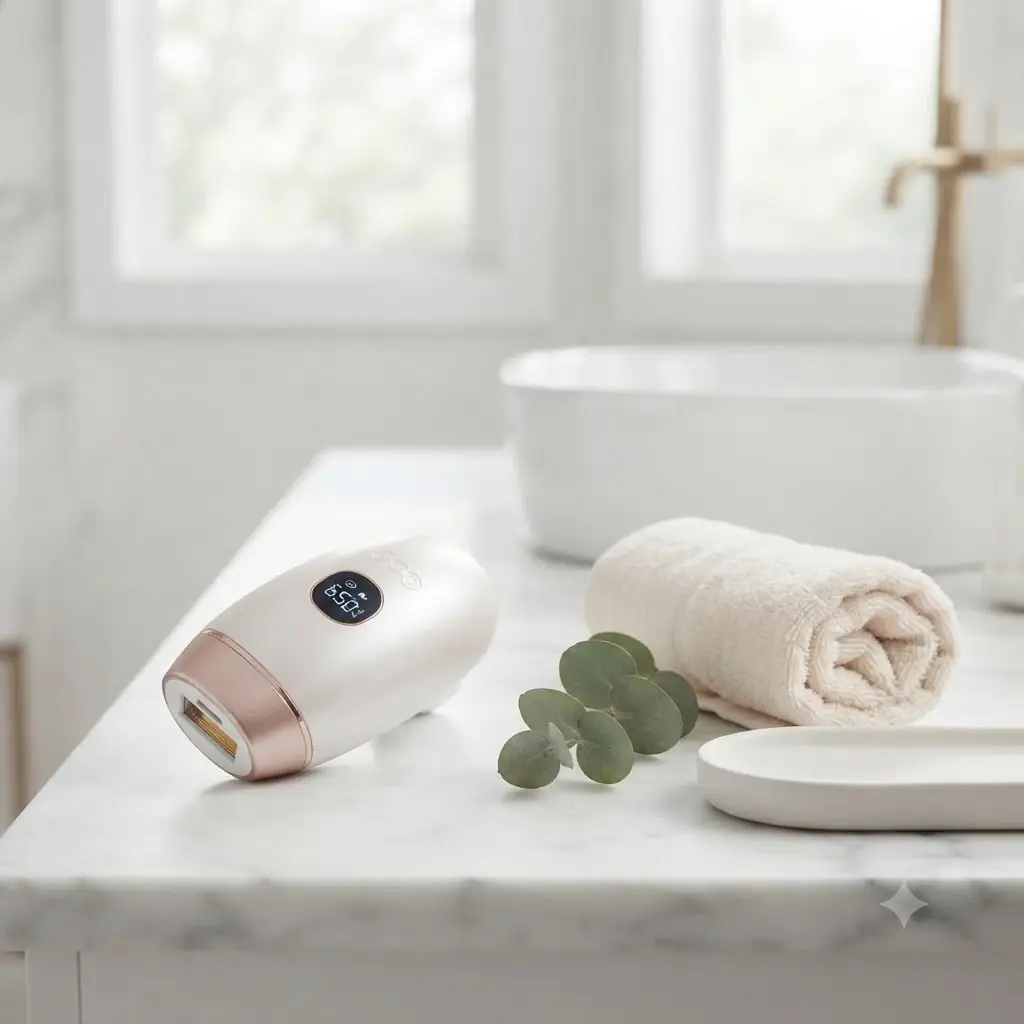
This is where the FlashSmooth Core earns its keep, honestly rather than with hype. It has an ice-cooling head that chills the skin at the moment of each flash, so higher energy levels feel like a warm tap instead of a sting. It also has a skin-tone sensor that reads your skin before firing and holds back if the tone is outside the safe range, which is a genuine safety feature rather than a gimmick. You can see the handset on our FlashSmooth Core page.
Who IPL works best for
This is where we have to be straight with you, because the science sets hard limits. IPL relies on a contrast between dark hair and lighter skin so the light can find its melanin target.
- Best results: light-to-medium skin (roughly Fitzpatrick types I to IV) with naturally dark brown or black hair. The contrast is high and the target is clear.
- Not suitable: very dark skin (Fitzpatrick types V and VI). The melanin in the skin itself can absorb too much of the light, which is both ineffective and unsafe. Clinic lasers designed for darker skin are a safer route.
- Will not work: blonde, red, grey, or white hair. These have little or no melanin, so there is simply nothing for the light to grab onto. IPL cannot treat what it cannot see.
The Fitzpatrick scale mentioned above is the standard dermatology system for classifying skin tone and how it responds to light. If you are unsure where you fall or whether IPL is right for you, our skin-tone suitability guide walks through it in detail, and reputable sources like the Cleveland Clinic also cover the pros and cons of at-home light hair removal.
How long until you see results
Patience is the price of IPL, so let us set honest expectations. Because of the growth cycle, results build gradually rather than appearing overnight.
- Around 4 to 8 weeks: the first visible change, usually slower and patchier regrowth as the earliest-treated follicles weaken.
- Around 12 weeks (roughly 8 to 12 sessions): fuller results, with noticeably less and finer hair across the area.
- Ongoing: occasional maintenance flashes to keep hair from creeping back, since IPL is reduction, not permanent removal.
If you want a grounded, evidence-led look at what results actually hold up over time, read our honest breakdown in does at-home IPL work, and if safety is your main question, see is at-home IPL safe.
FlashSmooth in one line
FlashSmooth Core turns the same clinic-grade science, light targeting pigment to slow regrowth, into a simple at-home routine with ice-cooling comfort and a skin-tone sensor, backed by a 90-day money-back promise. If your skin and hair are a good match, it is one of the easiest ways to trade lifelong shaving for lasting smoothness.
Understand the science, respect the growth cycle, stay consistent, and IPL rewards you with genuinely smoother skin, not with hype or false promises.